All posts by Mike Schadone

MEMORANDUM: Legal and Policy Risks of ALPR Contracts — A Response to Flock Safety

Re: Continuation or Renewal of Flock Safety ALPR Services

I. Purpose

This memorandum responds to Flock Safety’s representations regarding the legality and safety of its automated license plate reader (“ALPR”) network, and identifies concrete legal, financial, and reputational risks that should be resolved before any renewal.

II. Flock’s Legal Assurances Overstate Two Narrow, Non-Final Rulings

Flock frequently cites Schmidt v. City of Norfolk and State v. Simonson as establishing ALPR’s constitutionality nationwide. Neither supports that claim.

  • Schmidt v. City of Norfolk, No. 2:24CV621, 2026 WL 207513 (E.D. Va. Jan. 27, 2026), is a single district court’s summary judgment ruling, presently on appeal to the Fourth Circuit (No. 26-1227). The court limited its holding to Norfolk’s specific ~175-camera, 21-day-retention deployment and expressly warned that ALPR “could become too intrusive” as camera density increases — holding the system constitutional “today,” not permanently or generally.
  • State v. Simonson, No. 40732-2-III, 2026 WL 242157 (Wash. Ct. App. Jan. 29, 2026), is unpublished and carries no precedential value. Its actual holding concerns a single photograph from a single camera; the panel expressly declined to extend that holding to “the Flock system as a whole.” The trial court below described the networked system as comparable to cell-tower location tracking requiring a warrant under Carpenter v. United States.
  • The Supreme Court’s 2026 decision in Chatrie v. United States, 609 U.S. _, No. 25-112, reaffirmed that government reconstruction of an individual’s comprehensive movement history is a Fourth Amendment search, regardless of which private party initially collected the data. No court has yet ruled on Flock’s national, cross-jurisdictional lookup architecture, which operates at a scale and duration well beyond either Schmidt or Simonson.

A department relying on Flock’s characterization of “settled law” is relying on an overstatement of two narrow, appealable, fact-bound rulings.

III. Unauthorized Data Sharing Is a Documented, Recurring Pattern

Dayton, Ohio discovered more than 7,000 instances of its Flock data being accessed for immigration enforcement in violation of city policy, and physically disabled its own cameras before exiting its contract.
Multiple departments have found that Flock’s “National Lookup” and federal-sharing settings defaulted to on, exposing municipal data to the national network and federal agencies without the contracting department’s knowledge or consent.

The Los Angeles Police Department — the nation’s third-largest department — declined to renew its Flock contract in July 2026, its Chief Information Officer citing unresolved data ownership, sharing, and security concerns rather than cost.

More than 80 municipalities across over half the states have terminated Flock contracts since 2021, with the pace accelerating sharply through 2026.

IV. This Creates Direct Exposure for the Municipality, Not Just Flock

Public records liability. A department unable to fully account for who accessed its data, when, and why — because configuration is vendor-controlled — may be unable to satisfy public records obligations, inviting litigation and adverse fee awards.

Section 1983 exposure. If unauthorized third-party access causes constitutional injury to a resident, the municipality — not only Flock — may be named as the entity that deployed the surveillance and delegated data control without adequate contractual safeguards.
Shifting state law. Illinois, New Hampshire, Washington, and Virginia have enacted or are actively legislating ALPR-specific retention limits, warrant requirements, and use restrictions. A department locked into a multi-year contract may be unable to comply with new law without renegotiation, or may find itself in breach if use must be restricted.

Reputational and political risk independent of any ruling. The political cost of unauthorized federal data sharing and public records disputes has already proven sufficient to end large, high-profile contracts — LAPD, Dayton, Mountain View, and dozens of others — regardless of how the constitutional litigation resolves.

V. Questions Counsel Should Resolve Before Any Renewal

  • Does the department retain sole, auditable control over every data-sharing toggle — including national lookup and any federal-agency access — defaulted to off unless affirmatively enabled?
  • Can the department produce, on demand, a complete audit log of every external query against its data, including requesting agency and stated purpose?
  • Does the contract permit exit without loss of the department’s own historical data or continued vendor retention after termination?
  • Has counsel reviewed the contract against this state’s current and pending ALPR statutes?
  • Is the department prepared to defend the position that its specific deployment is materially indistinguishable from Schmidt and Simonson, given both are narrow rulings tied to specific camera counts and retention windows that may not match this department’s actual configuration?

VI. Conclusion

Flock’s public position — that courts have “consistently” upheld ALPR — describes two narrow, non-final, fact-bound rulings, not a settled national rule. Independent of how that litigation resolves, the documented pattern of unauthorized data sharing, public records exposure, and resulting contract terminations by comparable departments presents concrete, near-term risk regardless of any eventual constitutional ruling. Renewal should be conditioned on resolution of the questions above, with independent legal review of the contract’s data-sharing and audit provisions before further commitment.

Prepared for internal policy discussion and legal review. This memorandum is an advocacy document assembled to identify risk factors and does not constitute a legal opinion; municipal counsel should independently verify all citations and confirm current case status before relying on this analysis in any formal proceeding.

Constitutional Twilight: Purpose-Built Surveillance Infrastructure and the Fourth Amendment

A Case Study of Automated License Plate Recognition Networks

I. Introduction

The Fourth Amendment’s text has not changed since 1791. The technology arrayed against it has. Automated license plate recognition (“ALPR”) networks — exemplified by Flock Safety’s nationwide system, reported by industry and press sources as exceeding 100,000 cameras as of mid-2026, a figure this article has not independently verified — present the doctrine with a fact pattern the founding generation could not have anticipated and that even Carpenter v. United States, 138 S. Ct. 2206 (2018), did not squarely resolve: a privately manufactured, publicly and privately owned, artificial-intelligence-mediated network engineered from inception to function as a law enforcement search tool, indefinitely aggregating the movements of the general public without individualized suspicion.

This article argues that existing doctrine, properly extended rather than merely applied, supports Fourth Amendment scrutiny attaching earlier than the point of query — at the point a surveillance infrastructure is designed and deployed for the primary purpose of enabling law enforcement search. It further argues that this purpose-driven analysis, while doctrinally novel, is not doctrinally unmoored: it synthesizes threads already present in United States v. Jones, 565 U.S. 400 (2012), the special-needs “primary purpose” line of Ferguson v. City of Charleston, 532 U.S. 67 (2001), and City of Indianapolis v. Edmond, 531 U.S. 32 (2000), and Justice Gorsuch’s property-based dissent in Carpenter.

II. The Existing Doctrinal Baseline

A. Public Roads and the Third-Party Doctrine

Under Smith v. Maryland, 442 U.S. 735 (1979), and United States v. Miller, 425 U.S. 435 (1976), information voluntarily exposed to third parties historically carries no reasonable expectation of privacy. Lower courts applying this framework to ALPR include Schmidt v. City of Norfolk, No. 2:24CV621, 2026 WL 207513 (E.D. Va. Jan. 27, 2026) (Davis, J.), granting summary judgment for the city, and State v. Simonson, No. 40732-2-III, 2026 WL 242157 (Wash. Ct. App. Jan. 29, 2026) (unpublished). Both require substantially more qualification than the secondary sources this article originally relied on provided.

Schmidt is a live, precedential district-court decision presently on appeal as Schmidt v. City of Norfolk, No. 26-1227 (4th Cir., docketed Feb. 26, 2026; pending as of this writing). Judge Davis’s 51-page opinion held that Norfolk’s roughly 175-camera, 21-day-retention deployment did not track “the whole of a person’s movements” under Carpenter, but the opinion pointedly did not foreclose future challenges: the court wrote that ALPR surveillance “could become too intrusive” at “some point” as camera density increases, holding only that the system was constitutional “today.” That qualification is directly relevant to this article’s thesis and should not be omitted from any citation to the case.

Simonson requires a more significant correction. It is an unpublished opinion, carrying no precedential value under Washington GR 14.1, and — contrary to characterizations in several secondary sources, including a Flock-published blog post this article’s earlier draft relied on — it is not primarily a Fourth Amendment merits decision. The appeal arose from a trial court’s dismissal of stolen-vehicle charges under CrR 8.3(b) for the State’s failure to preserve ALPR data; the Court of Appeals reversed that dismissal on evidence-spoliation grounds. In the course of assessing prejudice, the panel did address the suppression question, but its merits holding is considerably narrower than “ALPR does not implicate the Fourth Amendment”: it held only that the single photograph actually before the court — one image, from one camera, reviewed by one officer — did not disturb the defendant’s private affairs under Article I, Section 7 of the Washington Constitution, and it expressly distinguished that narrow holding from “the Flock system as a whole,” which it acknowledged “potentially provides broader tracking capabilities.” Notably, the underlying trial court had gone further in the opposite direction, writing that the “expansive technological capabilities of the Flock system, which stores and retains searchable patterns of data… is far different than a single image,” and is “more analogous to how cell towers can track a person’s location and comprehensively chronicle their movements” — language that supports this article’s Part III–IV argument rather than undercuts it. Simonson should be cited, if at all, for its narrow single-photograph holding, not as general authority that networked ALPR querying survives Fourth Amendment scrutiny.

B. Carpenter’s Mosaic Theory

Carpenter carved a narrow but consequential exception: aggregated third-party records that reconstruct the “whole of a person’s movements” implicate the Fourth Amendment notwithstanding voluntary disclosure to the custodian, because such comprehensive retrospective tracking was not within the scope of risk a person assumes by using modern technology. The Court located the constitutional event at the point of government access — the compelled production and examination of Sprint’s records — not at the point Sprint created or retained them. This siting was deliberate: Sprint is not a state actor, and the Fourth Amendment does not reach purely private conduct.

Chatrie v. United States, 609 U.S. ___, No. 25-112 (June 29, 2026), reinforced this framework in the geofence-warrant context. Writing for a 6-3 majority, Justice Kagan held that police conducted a Fourth Amendment search when they obtained Okello Chatrie’s location data from Google via a geofence warrant, reasoning that an individual retains a legitimate expectation of privacy in the whole of his physical movements and that Carpenter’s logic controls notwithstanding the government’s argument that no search occurred at all. Justice Jackson, joined by Justice Sotomayor, concurred; Justice Gorsuch concurred in the judgment, presumably on his positive-law property theory discussed in Part V below; Justice Alito dissented in part, joined by Justice Thomas as to Part I and by Justice Barrett as to several subparts, and Justice Barrett filed a separate dissent. The case arose on certiorari from the Fourth Circuit’s en banc decision, United States v. Chatrie, 136 F.4th 100 (4th Cir. 2025), following the district court’s denial of the motion to suppress, United States v. Chatrie, 590 F. Supp. 3d 901 (E.D. Va. 2022). Chatrie did not resolve the constitutionality of fixed-location ALPR networks or Flock’s national lookup architecture, which involve a materially different collection method than the geofence warrant at issue, but its reaffirmation of Carpenter’s comprehensive-movement-tracking rationale is directly relevant to the query-stage analysis below.

III. Locating the Search Before the Query: A Purpose-Based Theory

A. Jones and the Road Not Fully Taken

Jones held that physically attaching a GPS device to a vehicle was itself a search, independent of whether the resulting data was ever examined — a trespass-based holding. Justice Alito’s concurrence, joined by three others, went further, locating the constitutional harm in the fact of prolonged monitoring rather than in any discrete act of installation or access. Justice Sotomayor’s separate concurrence flagged the distinct danger of government assembly of comprehensive records. Neither concurrence commanded a majority, and Carpenter’s majority opinion did not adopt this framing, choosing instead to locate the search at access.

B. The Primary-Purpose Doctrine as a Closer Analog

A more promising vehicle lies in the Court’s “primary purpose” jurisprudence. In Ferguson, the Court invalidated a hospital drug-testing-and-police-referral program because its primary purpose, assessed at the level of program design, was to generate evidence for law enforcement — not to treat patients. In Edmond, the constitutionality of a highway checkpoint program turned on its primary purpose, evaluated programmatically rather than stop-by-stop. Both cases stand for a proposition directly relevant here: where a program’s animating purpose is law enforcement investigation rather than an independent administrative or commercial function, that purpose is itself constitutionally significant, and courts assess it at the level of the program’s design — not only at the moment of individual application.

Applied to ALPR: Sprint’s cell-site database exists for billing; law enforcement access is incidental and post hoc. An ALPR network’s aggregation and search architecture — Flock’s “National Lookup,” cross-jurisdictional plate matching, and natural-language query tools — exists, by design and by the vendor’s own marketing, for law enforcement investigative search. A database whose primary purpose from inception is enabling government search arguably stands in a different constitutional posture than one whose law enforcement utility is a downstream, unintended byproduct of an unrelated commercial function.

A significant caveat is required here. Ferguson and Edmond do not hold that a program’s purpose determines whether a search has occurred at all; both cases assume a search is already conceded (a urine test, a vehicular stop) and use primary purpose only to determine what level of justification — ordinary probable cause versus a relaxed “special needs” standard — that already-conceded search requires. Extending that purpose-based reasoning to the antecedent question of whether a search has occurred at the design stage, before any individual application, is an analogical extension this article proposes, not a direct application of existing holdings. A rigorous referee should expect this move to be defended on its own terms rather than presented as settled by Ferguson or Edmond themselves.

IV. The State-Actor Question for Privately Owned Nodes

A substantial share of ALPR nodes — HOA, apartment complex, and private business cameras — are privately owned, raising a threshold question: can Fourth Amendment scrutiny attach to data collected by a private party at all?

A. The Jackson/Rendell-Baker Bar

Jackson v. Metropolitan Edison Co., 419 U.S. 345 (1974), and Rendell-Baker v. Kohn, 457 U.S. 830 (1982), establish that heavy government regulation or near-total government funding does not, standing alone, convert a private actor into a state actor. A private entity’s financial dependence on government contracts — even overwhelming dependence — is insufficient.

B. Reviving Joint Action Through Purpose

Skinner v. Railway Labor Executives’ Ass’n, 489 U.S. 602 (1989), permits a finding of state action where the government significantly encourages specific private conduct, or where a private party’s conduct is undertaken to serve a governmental function rather than an independent private one. This is where the primary-purpose analysis in Part III does double duty: a private camera operator whose device was purchased, installed, and configured specifically to feed a law-enforcement-searchable network — pursuant to a commercial product expressly marketed and architected for that governmental function — presents a materially different fact pattern from Rendell-Baker’s government-funded but functionally independent private school. The purpose-built character of the infrastructure is evidence of joint action that mere payment, without more, cannot supply.

V. An Alternative Path: Property and Custodial Obligation

Justice Gorsuch’s dissent in Carpenter proposed an approach the majority declined to adopt: that positive law — including bailment principles — may leave the data subject with a property interest in records physically held by a third-party custodian, such that Fourth Amendment protection does not evaporate merely because another party possesses the data. Under this framework, a government agency’s ALPR data remains, in a meaningful sense, the agency’s property notwithstanding Flock’s custodial possession and architecture; the vendor’s purpose-built search capability becomes a custodial arrangement structured to grant frictionless access to the beneficial owner — the government — a relationship warranting closer scrutiny than an unrelated business incidentally holding data of interest to police. No majority opinion has adopted this theory, but it offers a textually and historically grounded alternative that does not require resolving the state-action question at all for government-owned camera deployments.

VI. An Aggravating Factor: Biometric Convergence

A separate and underexplored risk concerns data-stream convergence. Current ALPR products, including Flock’s, do not store facial identity data — indeed, face-detection routines are used affirmatively to blur faces in stored imagery, a privacy-protective design choice. However, vendors in this space, including Flock’s own broader product suite, separately market facial-recognition-capable camera systems to the same public and private customer base operating on the same underlying platform. Should vehicle-movement data and facial-identity data ever be merged, cross-referenced, or made jointly queryable — whether by policy change, product integration, or unauthorized access of the kind already documented in several 2026 municipal audits — the “vehicle characteristics only, not identity” defense that currently forecloses stronger privacy claims would no longer describe the system in operation. Courts and legislatures assessing ALPR constitutionality on the current record should not treat the absence of biometric identification as a permanent structural feature; it is a policy choice within a single vendor’s control, on a platform architecturally capable of the alternative.

VII. The Overbreadth Objection and a Limiting Principle

Any design-purpose theory of this kind invites an obvious objection: nearly every law enforcement database — NCIC, state DMV records, fingerprint archives, booking photo repositories — is, in some sense, “purpose-built” to aid government search. If purpose alone triggers Fourth Amendment scrutiny at creation, the theory threatens to sweep in databases whose constitutionality has never seriously been questioned, and to do so without a workable stopping point.

The distinction this article proposes is not purpose alone but the combination of purpose and comprehensiveness of the underlying liberty interest at stake — specifically, aggregated, retrospective tracking of physical movement over time, the precise interest Carpenter identified as categorically different from discrete, static records. Fingerprint or booking-photo databases store static identifying information collected in connection with a specific, individualized law enforcement encounter (an arrest, a booking); they are not populated by continuously and indiscriminately monitoring the public at large. ALPR networks, by contrast, are populated by suspicionless, continuous, general-population surveillance whose aggregate product is a movement history indistinguishable in kind from the cell-site data at issue in Carpenter. The proposed design-stage scrutiny is limited to databases sharing both features — investigative purpose and suspicionless, continuous collection producing a comprehensive movement or associational record — and would not extend to conventional law enforcement recordkeeping populated through individualized, suspicion-based process. Whether this line can be administered consistently by courts, rather than merely stated, is a fair question this article does not fully resolve and flags as the theory’s principal vulnerability.

VIII. A Proposed Framework

Synthesizing the foregoing, this article proposes that Fourth Amendment analysis of purpose-built surveillance networks should proceed on three independent tracks, any one of which may suffice:

Query-stage scrutiny (settled ground): retrospective, cross-time, cross-jurisdiction queries capable of reconstructing a comprehensive movement history are searches under Carpenter and require a warrant, regardless of camera ownership. Narrow, real-time, single-target queries analogous to a traditional BOLO remain outside this rule.

Design-stage scrutiny (novel but doctrinally grounded): where a surveillance infrastructure’s primary purpose, assessed programmatically under Ferguson/Edmond, is to enable law enforcement search, constitutional scrutiny should attach to the government’s deployment and configuration of that infrastructure independent of any specific query — at minimum for government-owned nodes, and, on a joint-action theory, potentially for privately-owned nodes purpose-built for that function.

Custodial/property scrutiny (alternative, unadopted but available): government data held by a private vendor architected to provide frictionless law-enforcement access may be treated as remaining the government’s property for Fourth Amendment purposes under a bailment theory, obviating the need to resolve state action for the vendor’s conduct at all.

IX. Conclusion

No court has yet adopted the full synthesis proposed here. The query-based Carpenter theory remains the most litigated and best-supported avenue and should be regarded as the primary vehicle for near-term challenges. But the design-purpose and custodial-property theories are not speculative additions; they are extensions of reasoning already present, in fragments, across the Court’s own opinions. A network built, marketed, and sold expressly as a law enforcement search tool — regardless of who owns any individual node, and regardless of whether any individual query has yet occurred — sits closer to the general warrants the Fourth Amendment’s framers set out to foreclose than to the individualized, suspicion-based searches the Amendment was principally drafted to regulate. Doctrine has not yet caught up to that architecture. It should.

This article synthesizes analysis developed through Socratic dialogue and is offered as a framework for further legal research, not as a summary of settled law. Case citations reflect the state of authority as of July 2026 and, as to Schmidt v. City of Norfolk*,* State v. Simonson*, and* Chatrie v. United States*, have been verified against primary-source dockets and opinions rather than secondary reporting alone.* Schmidt remains on appeal to the Fourth Circuit and should not be cited as final; the correction of Simonson*’s scope in Part II.A above should be treated as authoritative over any prior secondary characterization of that case, including this article’s own initial draft.*

Anthrax Vaccine for Emergency Responders Petition

Anthrax Vaccine for Emergency Responders: Petition in support of the language of H.R. 1300 and S. 1915 to allow emergency responder access to nearly expiring anthrax vaccine from the Strategic National Stockpile

Anthrax vaccine is an important component of ensuring our providers' safety
Photo: D Mackinnon/Getty Images

Act NOW! Sign the PETITION!

Please join the 465 other citizens in signing this petition in support of the language of H.R. 1300 and S. 1915 by adding your name, town, and zip code to the form below. These bills allow emergency providers access to stockpiled anthrax vaccines.  Once enough names have been added to the petition, we will send the list of names to the U.S. Senate and to the President of the United States to ensure your voice is heard in support of the safety for all of America’s emergency first responders.

* Required fields

(*NOTE: We believe in privacy and will not sell or give your name or email address to anyone and is only used to help ensure against factitious signatories to the petition. The email addresses will be stripped from the petition prior to mailing.)

Background

Federal preparedness leaders are not acknowledging the potential of antibiotic-resistant anthrax and are not fully disclosing that antibiotics and personal protective equipment (PPE) may fail to protect first responders and volunteers as they perform their duties. Moreover, these federal stewards are unwilling or unable to share the anthrax vaccine and the protection it bestows. Instead, each year millions of federal, stockpiled doses of the anthrax vaccine expire, unused.

Project EQUIPP is a grassroots advocacy campaign formed in 2007 on behalf of local emergency responders and civilian preparedness volunteers and helped to develop a consensus paper calling for pre-exposure vaccination against anthrax for emergency responders. Shortly thereafter, the CDC Advisory Committee on Immunization Practices (ACIP) convened a working group that would ultimately revise the CDC guidance on the use of the anthrax vaccine. These CDC Recommendations were voted upon and approved in 2009. In its Notice to Readers published in MMWR in July 2010, the CDC states its support of voluntary, pre-exposure immunization with the anthrax vaccine for “persons involved in emergency response activities including but not limited to, police departments, fire departments, hazardous material units, government responders, and the National Guard.”

anthrax vaccine is the only way to prevent infection from antibiotic-resistant strains of <em>B. anthracis</em>
Bacillus anthracis bacteria, which causes the disease anthrax, is depicted here in a photograph that uses the Gram stain.
Credit: Public Health Image Library (PHIL), Center for Disease Control and Prevention

H.R. 1300: The First Responder Anthrax Preparedness Act

Subsequently, on July 29, 2015, the U.S. House of Representatives unanimously passed H.R. 1300, “The First Responder Anthrax Preparedness Act,” sponsored by Congressman Peter King (R-NY). According to the nonpartisan Congressional Research Service, “The First Responder Anthrax Preparedness Act”…

… amends the Homeland Security Act of 2002 to direct the Department of Homeland Security (DHS), in coordination with the Department of Health and Human Services (HHS), for the purpose of domestic preparedness for and collective response to terrorism, to:

  1. establish a program to provide surplus anthrax vaccines nearing the end of their labeled dates of use from the strategic national stockpile for administration to emergency response providers who are at high risk of exposure to anthrax and who voluntarily consent to such administration,
  2. distribute disclosures regarding associated benefits and risks to end users, and
  3. conduct outreach to educate emergency response providers about the program.

Requires DHS to:

  1. support homeland security-focused risk analysis and assessments of the threats posed by anthrax from an act of terror;
  2. leverage homeland security intelligence capabilities and structures to enhance prevention, protection, response, and recovery efforts with respect to an anthrax terror attack; and
  3. share information and provide tailored analytical support on threats posed by anthrax to state, local, and tribal authorities, as well as other national biosecurity and biodefense stakeholders.

Directs DHS, in coordination with HHS, to carry out a 24-month pilot program to provide anthrax vaccines to emergency response providers.
Requires DHS to:

  1. establish a communication platform and education and training modules for such program,
  2. conduct economic analysis of such program,
  3. create a logistical platform for the anthrax vaccine request process,
  4. select providers based in at least two states to participate,
  5. provide to each participating provider disclosures and educational materials regarding the benefits and risks of any vaccine provided and of exposure to anthrax, and
  6. submit annual reports on pilot program results and recommendations to improve pilot program participation.

Requires the report to include a plan for continuation of the DHS program to provide vaccines to emergency response providers.

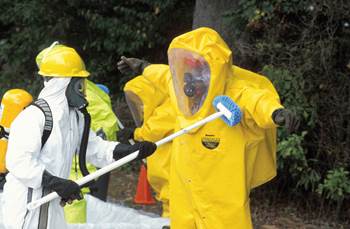
Haz-Mat Decon suits can fail - anthrax vaccine is an important component to provider safety
Photo: AR15.com

S. 1915: The First Responder Anthrax Preparedness Act

The Senate version of “The First Responder Anthrax Preparedness Act,” S. 1915, was introduced on August 3, 2015, by Sen. Kelly Ayotte (R-NH) and has been referred to the Committee on Homeland Security and Governmental Affairs where it sits today.

Cost

According to the nonpartisan Congressional Budget Office (CBO):

H.R. 1300 would direct the Department of Homeland Security (DHS), in consultation with the Department of Health and Human Services (HHS), to provide anthrax vaccines from the Strategic National Stockpile to first responders who volunteer to receive them. Under the bill, DHS would establish a tracking system for the vaccine and would provide educational outreach for the program. The bill would direct DHS, in coordination with HHS, to establish a pilot program in at least two states to begin providing the vaccine.

Based on information provided by DHS and HHS, CBO estimates that implementing H.R. 1300 would cost about $4 million over the 2016-2020 period, assuming appropriation of the necessary amounts. Enacting H.R. 1300 would not affect direct spending or revenues; therefore, pay-as-you-go procedures do not apply.

H.R. 1300 contains no intergovernmental or private-sector mandates as defined in the Unfunded Mandates Reform Act and would not affect the budgets of state, local, or tribal governments.

Act NOW! Sign the PETITION!

Please click here to sign this petition in support of the language of H.R. 1300 and S. 1915 to ensure your voice is heard in support of the safety for all of America’s emergency first responders.


101 Things We Should Teach Every New EMT

Originally posted at TheEMTSpot

I do not usually steal content or original writings, but this post is too important not to share (and keep for reference).  This was originally posted, with all credit due to the author of origin, at: http://theemtspot.com/2014/03/22/101-things-we-should-teach-every-new-emt/

Though this list is focused towards emergency medical technicians, it has inferred and inherent application in many clinical and non-clinical professions.

1) You aren’t required to know everything.

2) You are required to know the foundational knowledge and skills of your job. No excuses.

3) Always be nice. It’s a force multiplier.

4) There is no greater act of trust than being handed a sick child.

5) Earn that trust.

6) Don’t ever lie to your patient. If something is awkward to say, learn to say it without lying.

7) Read Thom Dick’s, People Care. Then read it again.

8) You can fake competence with the public, but not with your coworkers.

9) Own your mistakes. We all make them, but only the best of us own them.

10) Only when you’ve learned to own your mistakes will you be able to learn from them.

11) Experience is relative.

12) Proper use of a BVM is hard and takes practice.

13) OPAs and NPAs make using a BVM less hard.

14) Master the physical assessment. Nobody in the field of medicine should be able to hold a candlestick to your physical assessment skills.

15) Keep your head about you. If you fail at that, you’ll likely fail at everything else.

16) There is a huge difference between not knowing and not caring. Care about the things you don’t yet know.

17) Train like someone’s life depends on it.

18) Drive like nobody’s life depends on it.

19) Pet the dog (even when you’re wearing gloves).

20) Have someone to talk to when the world crashes down.

21) Let human tragedy enhance your appreciation for all that you have.

22) Check the oil.

23) Protect your back. It will quite possibly be the sole determining factor in the length of your career.

24) Say please and thank you even when it’s a matter of life or death.

25) Wipe your feet at the door.

26) When you see someone who is really good at a particular skill say, “Teach me how you do that.”

27) Nobody can give you your happiness or job satisfaction; it is yours and yours alone, and you have to choose it.

28) We can’t be prepared for everything.

29) We can be prepared for almost everything.

30) Check out your rig. It’s more meaningful that just confirming that everything is still there.

31) Tell your patients that it was a pleasure to meet them and an honor to be of service.

32) Mean it.

33) Keep a journal.

34) Make it HIPAA compliant.

35) Thank the police officer that hangs out on your scene for no good reason.

36) Recognize that he or she probably wasn’t hanging out for no good reason.

37) Interview for a job at least once every year, even if you don’t want the job.

38) Iron your uniform.

39) Maintain the illusion of control. Nobody needs to know that you weren’t prepared for what just happened.

40) Apologize when you make a mistake. Do it immediately.

41) Your patient is not named honey, babe, sweetie, darling, bud, pal, man or hey. Use your patient’s name when speaking to them. Sir and Ma’am are acceptable alternatives.

42) Forgive yourself for your mistakes.

43) Forgive your coworkers for their quirks.

44) Exercise. Even when it isn’t convenient.

45) Sometimes it’s OK to eat the junk at the QuickyMart.

46) It’s not OK to always eat the junk at the QuickyMart.

47) Don’t take anything that a patient says in anger personally.

48) Don’t take anything that a patient says when they are drunk personally.

49) Don’t ever convince yourself that you can always tell the difference between a fake seizure and a real seizure.

50) Think about what you would do if this was your last shift working in EMS. Do that stuff.

51) Carry your weight.

52) Carry your patient.

53) If firefighters ever do #51 or # 52 for you, say thank you (and mean it).

54) Being punched, kicked, choked or spit on while on duty is no different than being punched, kicked, choked or spit on while you’re sitting in church or in a restaurant. Insist that law enforcement and your employer follow up with appropriate action.

55) Wave at little kids. Treat them like gold. They will remember you for a long time.

56) Hold the radio mike away from your mouth.

57) There is never any reason to yell on the radio….ever.

58) When a patient says, “I feel like I’m going to die,” believe them.

59) Very sick people rarely care which hospital you’re driving toward.

60) Very sick people rarely pack a bag before you arrive.

61) Sometimes, very sick people pack a bag and demand a specific hospital. Don’t be caught off guard.

62) Bring yourself to work. There is something that you were meant to contribute to this profession. You’ll never be able to do that if you behave like a cog.

63) Clean the pram.

64) Clean your stethoscope.

65) Your patient’s are going to lie to you. Assume they are telling you the truth until you have strong evidence of the contrary.

66) Disregard #65 if it has anything to do with your personal safety. Trust nobody in this regard.

67) If it feels like a stupid thing to do, it probably is.

68) You are always on camera.

69) If you need save-the-baby type “hero moments” to sustain you emotionally as a caregiver you will likely become frustrated and eventually leave.

70) Emergency services was never about you.

71) The sooner you figure out #69 and #70, the sooner the rest of us can get on with our jobs.

72) People always remember how you made them feel.

73) People rarely sue individuals who made them feel safe, well cared for and respected.

74) You represent our profession and the internet has a long, long memory.

75) Don’t worry too much about whether or not people respect you.

76) Worry about being really good at what you do.

77) When you first meet a patient, come to their level, look them in the eyes and smile. Make it your habit.

78) Never lie about the vital signs. If the patients vital signs change dramatically from the back of the rig to the E.R. bed, you want everyone to believe you.

79) Calm down. It’s not your emergency.

80) Stand still. There is an enormous difference between dramatic but senseless action and correct action. Stop, think and then move with a purpose.

81) Knowing when to leave a scene is a vital skill that you must constantly hone.

82) The fastest way to leave a scene should always be in your field of awareness.

83) Scene safety is not a five second consideration as you enter the scene. It takes constant vigilance.

84) Punitive medicine is never acceptable. Choose the right needle size based on the patients clinical needs.

85) Know what’s happening in your partner’s life. Ask them about it after you return from your days off.

86) If your partner has a wife and kids, know their names.

87) No matter how hard you think you worked for them, your knowledge and skills are not yours. They were gifted to you. The best way to say thank you is to give them away.

88) Learn from the bad calls. Then let them go.

89) When you’re lifting a patient and they try to reach out and grab something, say, “We’ve got you.”

90) Request the right of way.

91) Let your days off be your days off. Fight for balance.

92) Have a hobby that has nothing to do with emergency services.

93) Have a mentor who knows nothing about emergency services.

94) Wait until the call is over. Once the patient is safe at the hospital and you’re back on the road, there will be plenty of time to laugh until you can’t breathe.

95) Tell the good stories.

96) You never know when you might be running your last call. Cherish the small things.

97) You can never truly know the full extent of your influence.

98) If you’re going to tell your friends and acquaintances what you do for a living, you’ll need to embrace the idea that you’re always on duty.

99) Be willing to bend the rules to take good care of people. Don’t be afraid to defend the decisions you make on the patients behalf.

100) Service is at the heart of everything we do. The farther away from that concept you drift, the more you are likely to become lost.

101) There is no shame in wanting to make the world a better place.

See more at: http://theemtspot.com/2014/03/22/101-things-we-should-teach-every-new-emt/

Changing the Paradigm of the Emergency Medical Services


Can the Emergency Medical Services Evolve to Meet the Needs of Today?

Click here to view the PowerPoint PDF

The emergency medical services (EMS) provide a means of rapid treatment and transportation to definitive care for those people who suffer immediate life-threatening injuries or illnesses (Department of Transportation, National Highway Traffic Safety Administration, n.d.; Mayer, 1980). There are a number of models across the country and the world that are seeking to redefine EMS in a way that is more meaningful in both of its missions, public safety and public health (Washko, 2012). However, financial constraints and overzealous regulations serve only to pigeon-hole EMS into the decade of its birth and refinement, the 1970s, by restricting incentive and growth and limiting the efficacy of directed research and its application towards the much needed restructuring of EMS.

In this brief literature review, I will examine the roots and context of EMS, its mission and current application, as well as possibilities for research, growth, and development. It is important to recognize that EMS is a grand resource for both public safety and public health, especially in light of the growing body of legislation that officials are using to redefine the current health care system within the United States. As we continue to develop EMS, other nations will look to us as they have in the past to adopt and adapt our system for use throughout the world.

A Brief History of Contemporary EMS

There were many forms of organized out-of-hospital medical aid provided throughout history from the biblical good Samaritan to the triage and extrication from the battlefields of the Roman conquests and the Napoleonic wars through the U.S. Civil War and every major war and conflict in U.S. history; however, it was not until the advent of combined mouth-to-mouth resuscitation and closed chest massage (what we know today as cardiopulmonary resuscitation, or CPR), enhanced 9-1-1 for use by the public in summoning emergency services, and the release of a 1966 white paper prepared by the Committee on Trauma and Committee on Shock of the National Academy of Sciences, National Research Council, that we have the EMS system that we are familiar with today (Department of Transportation, National Highway Traffic Safety Administration, 1996). It was about this time that the Department of Transportation (DOT) was given purview over EMS at the national level with the passage of the National Highway Safety Act of 1966.

During the 1970s, EMS had transitioned from mostly untrained funeral home drivers to providers trained by emergency physicians to treat many of the life-threatening scenarios that prevent people from seeking medical attention at hospitals, such as traumatic injuries, cardiac arrest, and many breathing problems. Since this time, there have been a number of concerted efforts and official recommendations by the DOT to augment and improve the delivery model of EMS throughout the country (Department of Transportation, National Highway Traffic Safety Administration, n.d., 1996, 2008). As early as 1996, the DOT published the vision of the future of EMS:

Emergency medical services (EMS) of the future will be community-based health management that is fully integrated with the overall health care system. It will have the ability to identify and modify illness and injury risks, provide acute illness and injury care and follow-up, and contribute to treatment of chronic conditions and community health monitoring. This new entity will be developed from redistribution of existing health care resources and will be integrated with other health care providers and public health and public safety agencies. It will improve community health and result in more appropriate use of acute health care resources. EMS will remain the public’s emergency medical safety net. (Department of Transportation, National Highway Traffic Safety Administration, 1996, p. iii)

Even as today’s emergency rooms, operating suites, and trauma centers throughout the world are overflowing capacity with an increasingly deficient workforce, EMS is expected to answer the call for help as the front-line of a fractured and inefficient health care system (Kellermann, 2006; Mason, Wardrope, & Perrin, 2003; O’Meara et al., 2006; Washko, 2012).

Hampered Efforts

EMS is known throughout the United States as rapid responders in times of medical and traumatic emergencies; however, ever-increasingly, EMS is being used as the front-line alternative to primary care for the non-emergent uninsured and under-insured patient population (Heightman & McCallion, 2011; Washko, 2012). There is a limited number of ambulances, EMTs, and paramedics available at any given moment, which is subject to financial constraints, and non-emergent use of these resources prevents their availability for when a true emergency arises. Secondary to the mission of providing care to the public, EMS is also needed to provide services for fire department and police department operations, such as firefighter rehabilitation at fire scenes and tactical medicine in concert with bomb squads, S.W.A.T. teams, and hazardous materials teams.

EMS resources are costly, and overburdened systems are negatively affected when these resources are misused, especially by those who are unwilling or unable to pay for the services.

Financial Impact

According to the DOT (2008) EMS workforce report, employers reported difficulties in retaining EMTs and paramedics partly due to the inability to raise wages or provide better fringe benefits. The report goes on to show that EMTs and paramedics suffer a wage disparity when compared to other similar public safety ($12.54/hr vs. firefighters: $26.82/hr; police officers: $22.25/hr) and health care workers (licensed vocational nurses and licensed practical nurses: $16.94/hr; respiratory therapists: $21.70/hr; registered nurses: $26.28/hr). In the five years leading up to 2005, the average wage for EMTs and paramedics grew only by $0.29/hr. It is important to note that these numbers do not take cross-trained firefighters and police officers into consideration.

Furthering the concern of wages, as the DOT (2008) report shows, is the lack of growth potential within EMS as most systems lack the ability to provide a meaningful career ladder to the EMTs and paramedics in their employ. These circumstances together create the scenario that EMS is an underpaid dead-end job causing high attrition as most EMTs and paramedics either suffer from burnout, culminated psychological stress from the job, or use the profession as a stepping stone into other health care fields, such as nursing, respiratory therapy, or physician-level medicine.

The DOT (2008) report provides evidence that transport-based reimbursement policies are likely to blame for the unusually low profit margin in EMS (Heightman & McCallion, 2011). The Medicare and Medicaid programs, as well as many private insurers, require documentation that the transport of a patient be medically necessary before they will pay; however, the Medicare and Medicaid reimbursement rates are very low and do not cover the cost of EMS operations. To complicate the matter, EMS providers are mandated by law to provide care to the public regardless of their insurance status or ability to pay (Heightman & McCallion, 2011). EMS is subsidized by either taxes or insurance reimbursement or some combination of the two.

Broad Mission

In addition to providing for the mundane care and transportation of the ill and injured and performing ancillary duties for the police and fire departments as noted above, EMS is tasked with disaster preparedness – preparing for the major incident that is highly unlikely to occur but would be devastating to lives and infrastructure if it does. That is if the EMT or paramedic is employed for an emergency service. Many of the EMTs and paramedics, today, are employed by private ambulance services who transport non-emergent patients to and from skilled nursing facilities and doctors’ offices. The multitude of these EMTs and paramedics are not considered when planning for emergency response schemes.

I consider EMS to be the caulking used to fill many of the fractures and gaps in today’s health care system. If it occurs outside of the hospital, then EMS will take responsibility, yet, they seldom get paid for their actions.

Proposed Solutions

There has been much talk over the past few years regarding the efficacy and efficiency of EMS, and all agree that the current definitive model is inefficient with, at best, questionable efficacy. Washko (2012) describes in detail the number of EMS schemes and their shortfalls. In his article, Washko is correct in stating that transport-based reimbursement policies fail to reward the greater EMS community for their willingness to take on further responsibility within the two scopes of operation: public health and public safety.

Wingrove and Laine (2008) explore the opportunity for training and equipping the most experienced paramedics for a public health centered role delivering community-based care. These community-based paramedics are described as augmenting the traditional emergency responder role with opportunities to direct patients to more appropriate care, such as doctor’s offices and urgent care centers instead of hospital emergency departments when appropriate to their condition. This model was researched recently in Australia with good results, and is now a recommended career path both there and in the United Kingdom (Mason, Wardrope, and Perrin, 2006; O’Meara et al., 2012). In the U.S., EMS professionals feel a responsibility to participate in disease and injury prevention efforts, and research on models that utilize specially-trained paramedics to perform home safety inspections, hazard mitigation, and reduce the risks of injuries to children have proven effective (Hawkins, Brice, & Overby, 2007; Lerner, Fernandez, & Shah, 2009). Hennepin Technical College, in Minnesota, now offers certification in Community Paramedic training when the recommended curriculum is provided by an accredited college, according to Wingrove and Laine.

Other, more immediate (but, arguably, less meaningful) solutions, as Washko (2012) describes, are incorporating operational tactics that better utilize ambulances by attempting to predict call volumes and locations based on historical data, the high-performance model. This, however, creates high-call volume, less resource driven scenarios with ambulances idling on street corners awaiting the next call. As mentioned earlier, attrition is a significant concern in EMS and these tactics are demanding on providers physically and psychologically leading to high incidences of burnout and injury (Department of Transportation, National Highway Traffic Safety Administration, n.d., 2008).

Discussion

The standard operational benchmarks of EMS – response times and mortality and morbidity of cardiac arrest – are antiquated measures and typically distract policymakers when they are considering financial incentives for EMS (Heightman & McCallion, 2011; Washko, 2012). EMS needs to evolve with the changing health care system, and I feel that it is poised, specifically, to help address disparities in health and health care. Using the community-based paramedic model of health care delivery, we can address many public health concerns, provide for public safety, and still maintain the traditional role of emergency responder. The community-based paramedic model will provide an acceptable alternative to the options that lie ahead.

The economics of health care is a reality that must be considered by every EMS operation when approaching growth and change. As long as EMS can fill the gaps in the current health care system, it will be worth the money required to subsidize a robust, well-trained, and well-equipped contingent of emergency medical professionals. In the meantime, though, EMS agencies will have to seek more efficient models that maximize reimbursement while minimizing costs.

References

Committee on Trauma & Committee on Shock, Division of Medical Sciences, National Academy of Sciences, National Research Council. (1966). Accidental Death and Disability: The Neglected Disease of Modern Society. Washington, D.C.: Author.

Department of Transportation, National Highway Traffic Safety Administration. (n.d.). A leadership guide to quality improvement for emergency medical services (EMS) systems (Contract DTNH 22-95-C-05107). Retrieved from http://www.nhtsa.gov/people/injury/ems/Leaderguide/index.html

Department of Transportation, National Highway Traffic Safety Administration. (1996). Emergency medical services: agenda for the future (DOT HS 808441 – NTS-42). Retrieved from http://www.nremt.org/nremt/downloads/EMS%20Agenda%20for%20the%20Future.pdf

Department of Transportation, National Highway Traffic Safety Administration. (2008). EMS workforce for the 21st century: a national assessment. Retrieved from http://secure.naemse.org/services/EMSWorkforceReport.pdf

Hawkins, E. R., Brice, J. H., & Overby, B. A. (2007). Welcome to the World: Findings from an emergency medical services pediatric injury prevention program. Pediatric Emergency Care, 23(11), 790-795. doi:10.1097/PEC.0b013e318159ffd9

Heightman, A. J. & McCallion, T. (2011). Management lessons from Pinnacle: Key messages given to EMS leaders at the 2011 conference. Journal of EMS, 36(10), 50-54.

Kellermann, A. L. (2006). Crisis in the emergency department. New England Journal of Medicine, 355(13), 1300-1303. doi:10.1056/NEJMp068194

Lerner, E. B., Fernandez, A. R., & Shah, M. N. (2009). Do emergency medical services professionals think they should participate in disease prevention? Prehospital Emergency Care, 13(1), 64-70. doi:10.1080/10903120802471915

Mason, S., Wardrope, J., & Perrin, J. (2003). Developing a community paramedic practitioner intermediate care support scheme for older people with minor conditions. Emergency Medicine Journal, 20(2), 196-198. doi:10.1136/emj.20.2.196

Mayer, J. D. (1980). Response time and its significance in in medical emergencies. Geographical Review, 70(1), 79-87. Retrieved from http://www.ircp.info/Portals/22/Downloads/Performance/Response%20Time%20and%20Its%20Significance%20in%20Medical%20Emergencies.pdf

National Traffic and Motor Vehicle Safety Act of 1966, Pub. L. No. 89-563, 80 Stat. 718 (1966).

O’Meara, P., Walker, J., Stirling, C., Pedler, D., Tourle, V., Davis, K., … Wray, D. (2006, March). The rural and regional paramedic: moving beyond emergency response (Report to The Council of Ambulance Authorities, Inc.). Retrieved from http://www.ircp.info/Portals/22/Downloads/Expanded%20Role/The%20Rural%20and%20Regional%20Paramedic%20Moving%20Beyond%20Emergency%20Response.pdf

Washko, J. D. (2012). Rethinking delivery models: EMS industry may shift deployment methods. Journal of EMS, 37(7), 32-36.

Wingrove, G. & Laine, D. (2008). Community paramedic: A new expanded EMS model. Domain3, 32-37. Retrieved from http://www.ircp.info/Portals/22/Downloads/Expanded%20Role/NAEMSE%20Community%20Paramedic%20Article.pdf

Communications: Multicultural Considerations

Episcopalians have recently decided to approve and bless this type of marriage within the church (Dawson, 2012). In light of the recent debate over same-sex marriage, which has implications for societal values, health care, economics, public policy, business, and religion, approaching the subject requires care and specific messaging to ensure factual representation of the lesbian, gay, bisexual, and transgendered (LGBT) community with limited personal bias. A biased or overly-stereotypical argument of debate or discussion point is easily nullified and serves only to discredit the messenger. According to James (2011) and Robison (2002), between 4 and 10% (14.4 – 36-million) of all Americans fall within the LGBT community. Additionally, as religion appears to be the countering force in this argument, the same care must be used for this group, also.

If I were to enter the debate, I would hope to provide a solution to the problem that would be equitable to all parties involved. If not realistic, it would, at least, be a positive addition to the debate; however, I feel that there is an equitable solution. The only was to reach this solution, though, is to maintain a factual position from which to analyze the problem. Hendrix and Hayes (2010) focuses on message construction, and though it is an important aspect of communications, public debate usually requires research more focused to attain understanding of the intricacies of the debate and the environment in which the debate is being held.

There are two aspects of marriage that need to be considered. First, marriage is largely a religious institution; therefore, the religious debate cannot be readily dismissed. The second aspect of marriage that needs consideration is legal definition of marriage and the licensing requirements of each state. Obvious to me, the federal government has no platform on which to stand as they are required to honor the states’ license of marriage. The rapid solution is to provide a state option to allow or disallow same-sex marriage. For this to occur, the states would have to change the marriage license to a license of partnership in household. The partnership in household designation would allow, for tax and legal purposes, the LGBT community as well as others, such as atheists, to enjoy the benefits of traditional marriage without encroaching on the purview of religion. This would leave each religious denomination the choice of presiding over a formal rite of wedding, which would officiate the marriage within the religion. The states and federal government should only honor the partnership in household designations or dissolutions when considering marriage for their purposes. Marriage is the only religious rite where government requires a fee, and they should not.

This solution provides historical precedent as well as satisfying the needs of the communities on each side of this debate, and it does so respectfully and without bias. Other arguments can still be made, such as the worthiness and value of society’s acceptance of same-sex marriage, but these arguments are less important than the official capacity in which each aspect of the argument (government and religion) are able to weigh in. Too many times, we as a society try to use institutions to force behavior when the chosen institution actually has little purview and impact on the behavior, such as the federal government in this case. This tactic only serves to inflame the debate and adds pressure to institutions to act.

References

Dawson, D. (2012, July 9). Episcopalians set to be first big U.S. church to bless gay marriage. Reuters. Retrieved from http://www.reuters.com/article/2012/07/10/us-usa-religion-gaymarriage-idUSBRE86902U20120710

James, S. D. (2011, April 8). Gay Americans make up 4 percent of population. ABC News. Retrieved from http://abcnews.go.com/Health/williams-institute-report-reveals-million-gay-bisexual-transgender/story?id=13320565#.T_1wIOFySOw

Hendrix, J. A. & Hayes, D. C. (2010). Public relations cases (8th ed.). Boston, MA: Wadsworth Cengage Learning.

Robison, J. (Ed.). (2002, October 8). What percentage of the population is gay? Gallup. Retrieved from http://www.gallup.com/poll/6961/what-percentage-population-gay.aspx

Integrated Marketing Communications Case Study

Integrated marketing communication provides a seamless and comprehensive delivery of information to consumers. Hendrix and Hayes (2010) discusses the prevalence of integrated marketing since the 1990s and its usefulness in complying with the perceptions of consumers. In this way, integrated marketing communication is consumer-centric and relationship driven. An award-winning case study of Pfizer Animal Health, MGH, and TagTeam Global by the Public Relations Society of America (2009) demonstrates the utility of integrated marketing concepts.

Background

Pfizer developed a canine weightloss medication, Slentrol®, in 2007, and relied on the collaborative efforts of MGH and TagTeam Global to launch the marketing efforts in 2008. Slentrol® is the first-in-class drug approved by the Food and Drug Administration to treat canine obesity. The comprehensive effort resulted opening conversations between veterinarians across the country and approximately 200,000 dog owners, increasing dog obesity awareness, and, ultimately, lead to a 42% gain in Slentrol® sales.

Research

Hendrix and Hayes (2010) describe how a SWOT analysis would be extremely useful when preparing for an integrated marketing effort. They stress that leveraging strengths and acknowledging weaknesses honestly allows the firm the ability to maximize market-share while maintaining vigilance against external threats. According to the Public Relations Society of America (2009), the primary research, conducted primarily by Pfizer, helped to define the market. MGH and TagTeam Global furthered this research with anecdotal evidence provided by friends, family, and colleagues and surveys directed to veterinarians, which helped to define the degree of understanding that most people have of the health risks of obese dogs. MGH and TagTeam Global also performed secondary research to help to define the messaging in a way that would resonate with dog owners.

Objectives

The objectives of integrated marketing communications is, by definition, comprehensive. In the case study, the objectives included increasing a focus on canine obesity, educate dog owners to the dangers and risks of canine obesity, motivate dog owners to seek treatment if their dogs were perceived to be obese, and to increase sales of Slentrol® (Public Relations Society of America, 2009). To meet these objectives, a public outreach event, the National Canine Weight Check, was designed to allow dog owners to visit a participating veterinarian during an entire month for a weight assessment free of charge (Public Relations Society of America, 2009).

Programming

The Public Relations Society of America (2009) case study demonstrates a varied use of media and consumer word-of-mouth communication to raise awareness of canine obesity. MGH and TagTeam Global also created a website dedicated to provide education about canine obesity and recruited a number of veterinarians to participate in the outreach. These veterinarians were provided with advice on how to broach the topic as well as the necessary equipment to perform the free weight assessment. Again, they relied heavily on the previous research in order to communicate most effectively with dog owners based on the vernacular present on canine websites and discussion boards. This was a very strategic use of available communication tools.

Evaluation

The National Canine Weight Check is lauded as attracting over 200,000 dog owners to participating veterinarians to discuss the risks and options concerning their overweight dogs, Pfizer enjoyed a 42% increase in sales of Slentrol®, and Pfizer realized a great opportunity for continued marketing to almost 1,500 consumers through social network connections (Public Relations Society of America, 2009). Many other goals and objectives were met, and Pfizer, MGH, and TagTeam Global consider the National Canine Weight Check a large success.

Discussion

Integrated marketing communications is a comprehensive combination of many advertising, marketing, sales, and public relations tactics to provide unification in the messaging and more effectively leverages the strengths of the organization. Integrated marketing relies on two-way communication and serves to establish long-lasting relationships between the organization and consumers. Integrated marketing can be very useful in a myriad of situations, and though it requires great attention to detail and thorough research to accomplish effectively, the rewards can be immense and lasting when done right.

Pfizer, MGH, and TagTeam Global would not, in my opinion, have benefited from such success had they not implemented this comprehensive approach. The research alone allowed the effort to succeed by uncovering more ways to attain credibility with the consumers as well as veterinarians (Public Relations Society of America, 2000). Further, the biggest benefit to integrated marketing that Pfizer now enjoys is the long-term loyalty and commitment found in a significant share of the market. This could not be attained, according to Hendrix and Hayes (2010), with other, more modest, forms of communication and marketing.

References

Hendrix, J. A. & Hayes, D. C. (2010). Public relations cases (8th ed.). Boston, MA: Wadsworth Cengage Learning.

Public Relations Society of America. (2009). National canine weight check (Product #6BW-0916A11). Retrieved from http://www.prsa.org/Awards/SilverAnvil/

ROPE Process in Consumer Relations

Public relations is a very useful tool for an organization making its case in the public forum, especially when confronting another organization with conflicting values. In this case, I will explore the opportunity for using public relations concepts in defending a historical society against the desire of a group of property developers who wish to build on an historic site. Hendrix and Hayes (2010) demonstrates leveraging reputation and crafted messaging to inform the public of the controversy in a manner that helps to garner public support for the organization’s position using the R.O.P.E. (research, objectives, programming, and evaluation) process.

Research

The first step in using public relations, according to Hendrix and Hayes (2010) is researching the problem and the audience. The results will allow tailoring the later message to effectively impact the audience in the desired manner. Tailoring the message specifically to the audience is very effective in communications. Research is especially important in separating those who are active in community politics from those who prefer a more laissez-faire approach to politics.

In this particular case, it is important to understand the import that the members of the community put on history, their political ideologies, and the economic impact of the developers’ proposed plan. Depending on how each of these relate to the current state of the community, a message could be crafted to emphasize the points most important to the community as well as educate the public to the importance of the issue.

Objectives

Hendrix and Hayes (2010) state that both impact and output objectives are important when communicating with consumers. Impact objectives refer to the attitudes and behaviors that need to be influenced while output objectives refer to the overall measurable goals of the public relations effort. While the latter can be simply stated as to garner support to preserve the historic nature of the site, the former requires more precision.

Using the broad output objective statement above, further output objectives can be developed to meet the overarching goal. For example, a more specific output objective could be to mail informational flyers to each household within five miles of the historically significant site. Another example would be to meet with three previously identified community leaders each day to emphasize the importance of preserving the site versus developing it.

In this particular case, the impact objectives will rely heavily on the research performed to increase the community’s knowledge about the importance of historical preservation and to influence their perceptions of the usefulness of historical preservation contrasted with the negative impact of the development of the site. Further, the community needs to be educated about how the historical preservation society has performed in past years with a focus on those efforts that typical have the support of the public already.

Programming

As stated above, the programming of the message is very important and should be steered by the research. In the case of an historical preservation society attempting to protect an historic site from development, there will be media coverage. It is important to control the media as much as possible, and this can be accomplished by issuing press releases (see Appendix), holding public events covered by the media designed to educate the public about the controversy, and holding press conferences and interviews to give the media more access to the desired message over the competing message of the developers. The programming also needs to enhance and leverage the credibility of the historical society for the best results (Hendrix & Hayes, 2010).

Message programming can also be used in monitoring media coverage and augmenting the approach based on the amount and content of coverage. If one aspect of the message is clearly represented but another aspect is failing to connect with the public, emphasis can be placed on the lacking aspect of the message in future communications.

Evaluation

The reputation and credibility of the historical preservation society is very important in the continued efforts to garner support for preserving the site from the proposed development; therefore, constant evaluation of the society’s reputation within the community is paramount. Beyond the reputation, the effectiveness of each message component should be evaluated to ensure consistency with the objectives. This could be accomplished by using further research and analyzing the amount of favorable attention the society is getting in regards to this particular controversy and in general.

Understanding the effectiveness of the communication effort allows a decision to made to either stay on course or alter the messaging to use more effective measures and tactics.

Discussion

Though this controversy is hypothetical, political discussions and debates frequently call into the question to utility and desire of maintaining historical sites versus the opportunity to develop these sites to improve economic output or improve overall living conditions within the community. For those that feel an importance in preserving history when confronted with political controversy, the communication efforts described here can be used to effectively plead the case in the public forum, arguably the most important forum in controversies such as these.

References

Hendrix, J. A. & Hayes, D. C. (2010). Public relations cases (8th ed.). Boston, MA: Wadsworth Cengage Learning.

Appendix

Example press release.

Contact: Michael Schadone FOR IMMEDIATE RELEASE

Telephone: (555) 555-5555

Cell: (555) 555-5556

Email: info@historicalsoc.org

SAVE OUR SITE

Please Help Preserve the Johnson Mills

The Society of Historical Preservation has recently learned that the Johnson Mills site, located at 55 Johnson Rd. in Township, Connecticut, is in danger of being destroyed. This site, an historically significant building where our first governor, John Johnson, founded the lumber mill that propelled our state into prosperity for over 300 years, is important to the economic and political history of the state as well as the nation.

On May 5, 2012, Property Developers, Inc., submitted a proposal to the Township zoning board to develop the Johnson Mills historical site as condominiums and a strip mall. We believe that, although the community of Township is very supportive of preserving the history of the region, this proposal will be approved unless the members of the community attend the next zoning board hearing on July 25, 2012, at 123 Government Ln., to express their concern over the needless destruction of this important site.

Further, Township is experiencing the same economic conditions as the rest of the country and home ownership is at an all-time low for the region. In addition to the historic importance of Johnson Mills, it seems that the creation of a condominium complex is contrary to the needs of the community.

We at the Society of Historical Preservation anticipate that the people of Township and others within the state would be dismayed to hear of the plans of Property Developers, Inc., to develop the Johnson Mills site. It is important for us to give the community the opportunity to oppose this proposal by calling the Township town hall at (555) 555-0001 and attend the upcoming hearings to voice their concerns.

# # #

If you would like more information on this topic, or to schedule an interview with Michael Schadone, please call Steve Smith at (555) 555-5557 or email Steve at contact@historicalsoc.org

Penn State: Analysis of Crisis Communications

On November 5, 2011, Jerry Sandusky, former Pennsylvania State University assistant football coach, was arrested on a number of counts of sexual assault on a minor. The arrest stems from incidents relating to The Second Mile charity, founded by Sandusky, and its association with Pennsylvania State University over the course of 15 years (Garcia, 2011; “Sandusky,” 2011). Two days later, the Pennsylvania State University athletic director, Tim Curley, and senior vice president for finance and business, Gary Schultz, surrendered to police to answer charges for failing to notify authorities for suspicions of sexual abuse of a minor (“Officials,” 2011; “Sandusky,” 2011). In two more days, Joe Paterno, head coach of the Pennsylvania State University football program, resigned over the controversy surrounding the university and its football program (Garcia, 2011; “Sandusky,” 2011). Within days of the arrests (and, before all the facts are known), the university was being severely criticized in the media (Zinser, 2011). This public relations nightmare is an example of how leveraging a crisis communication plan is important in communicating with the public.

Trivitt and Yann (2011) present this case as a reminder that crisis managers cannot fix every problem: “we think it’s important that, as a profession, we don’t overreach and try to uphold our work as the savior for every societal tragedy and crisis. Doing so makes us look opportunistic and foolish considering the gravity of the situation” (para. 13). In the case of Pennsylvania State University, there were a number of glaring failures to report the assaults to the authorities. Still, Sandusky was allowed to have unsupervised interaction with these adolescent boys until an investigation was launched in 2009 after one of the victims notified the authorities (“Sandusky,” 2011). Pennsylvania State University authorities should have reported the accusations to the proper authorities and released a statement to the media as soon as they were made aware, saving the administration from this crisis (Sudhaman & Holmes, 2012). The perception, however, is that there was a cover-up of moral corruption. There were a number of moral requirements that university representatives failed to acknowledge over the past years, and the character and esteem of the school will suffer for it.

Immediately after the revelation of these transgressions, the Pennsylvania State University administration clambered to make the proper attempts towards repairing the school’s suffering reputation, including donating $1.5-million of profits received from the renowned football program to sex crimes advocacy projects, discontinuing the school newspaper’s sex column, and providing a town hall- type venue where concerned students could present their questions and concerns directly to school officials (Sauer, 2011). Ultimately, these steps are proper; however, the only means of reclaiming and recapturing the admirable reputation that Pennsylvania State University once held is time and requires purging those administrators who appear sullied by this controversy. This does not, however, mean that Pennsylvania State University is languishing. According to Reuters (Shade, 2011), applications to attend Pennsylvania State University have increased in the last year, and the current school administration, as well as alumni, are uniting to restore the trust between the school and students.

Further, Singer (2011), a crisis communications and reputation management specialist, outlines the steps necessary for the school to truly enhance its brand. Singer highlights cleaning the slate by terminating any employees explicitly related to or having perpetuated the crisis, creating a team-centric leadership culture by restraining the political power of any one person within the school (especially the lead coach), and living the values that are proffered by the school (e.g. “Success With Honor”). If the crisis is handled appropriately from this point forward, the school’s reputation will be judged not the crisis itself.

Discussion

Coombs (2012), Fearn-Banks, (2011), and Hendrix and Hayes (2010) all agree that crises are unexpected events that are difficult to anticipate; however, the communications focus should not be placed on specific problems that have a low probability of materializing but to have broad and general preparations in place to address unanticipated concerns as they arise.

Hendrix and Hayes (2010) provides an emergency checklist that organizations could adopt to better prepare to respond rapidly to a crisis. Analyzing the Pennsylvania State University response in retrospect by applying the concepts within this checklist will show how poorly prepared the administration was in responding to this crisis. What is glaring in the analysis is that the administration was on the defensive throughout the entire crisis. It seems that they were either unwilling or unable to get in front of the story. Hendrix and Hayes, as well as Coombs (2012) recommends utilizing a central resource as a clearinghouse to disseminate information to and from external publics. This communications center could also serve as an incident knowledge-base for those internal publics requiring more information. Further, preparation, again, is explicitly stated and is a requirement to quickly respond to media inquiries within the hour recommended. Although it is unclear if Pennsylvania State University incorporated a public information center, it was clearly not effective if it was, indeed, instituted.

Another issue that was contentious throughout the crisis and gave the appearance of a cover-up was the lack of full disclosure on the part of the university. It is understandable that the administration might have been caught off guard; however, this is no excuse to appear defensive and largely silent.

The Pennsylvania State University administration later contracted with a public relations firm to restore the reputation of the university. This should have been done much earlier.

References

Coombs, W. T. (2012). Ongoing crisis communication: Planning managing, and responding (3rd ed.). Thousand Oaks, CA: Sage.

Fearn-Banks, K. (2011). Crisis communications: a casebook approach (4th ed). New York, NY: Routledge.

Garcia, T. (2011, November 9). Paterno announces retirement, says Penn State has bigger issues to address. PRNewser. Retrieved from http://www.mediabistro.com/prnewser/paterno-announces-retirement-says-penn-state-has-bigger-issues-to-address_b29902

Hendrix, J. A. & Hayes, D. C. (2010). Public relations cases (8th ed.). Boston, MA: Wadsworth Cengage Learning.

Officials seeking alleged abuse victims. (2011, November 9). ESPN.com. Retrieved from http://espn.go.com/college-football/story/_/id/7203566/penn-state-nittany-lions-sex-abuse-case-officials-arraigned-police-seek-alleged-assault-victim

Sandusky, Penn State case timeline. (2011, November 9). ESPN.com. Retrieved from http://espn.go.com/college-football/story/_/id/7212054/key-dates-penn-state-sex-abuse-case

Sauer, A. (2011, December 1). Penn State bogs down in PR crisis, but a turnaround already showing. brandchannel. Retrieved from http://www.brandchannel.com/home/post/2011/ 12/01/Penn-State-Bogs-Down-In-PR-Crisis-120111.aspx

Shade, M. (2011, December 1). Penn State officials say applications up despite scandal. Reuters. Retrieved from http://www.reuters.com/article/2011/12/01/us-crime-coach-students-idUSTRE7B00GD20111201

Singer, J. (2011, December 7). The Penn State scandal: crisis as opportunity. The Business of College Sports. Retrieved from http://businessofcollegesports.com/2011/12/07/the-penn-state-scandal-crisis-as-opportunity/

Sudhaman, A. & Holmes, P. (2012, January 25). The top 10 crises Of 2011. The Holmes Report. Retrieved from http://www.holmesreport.com/featurestories-info/11377/The-Top-10-Crises-Of-2011.aspx

Trivitt, K. & Yann A. (2011, November 9). Public relations won’t fix Penn State’s crisis. PRSay. Retrieved from http://prsay.prsa.org/index.php/2011/11/09/public-relations-wont-fix-penn-states-crisis/

Zinser, L. (2011, November 9). Memo to Penn State: Ignoring a scandal doesn’t make it go away. The New York Times. Retrieved from http://www.nytimes.com/2011/11/10/sports/penn-state-fails-a-public-relations-test-leading-off.html?_r=1&ref=sports

EMS Research: Using t Tests

When considering the emergency medical services, there has been much discussion regarding the utility of advanced life support and its effectiveness within the emergency medical services (Stiell et al., 2005; Stiell et al., 2003; Stiell et al., 2002; Stiell et al., 1999). One of the most basic skills that paramedics use exclusively is intravenous cannulation and the subsequent delivery of isotonic intravenous fluid. Intravenous cannulation is one of the first advanced skills that paramedics utilize within the course of treatment as it allows to correct for shock, provides a means for administering parenteral medications, and provides a means for drawing blood for testing either in the field or upon arrival at the receiving emergency department. As the body’s stress increases when dehydration is present, it is imperative to correct dehydration during the course of treating most ailments; otherwise, the body’s own compensatory mechanisms can fail despite otherwise adequate treatment (Wakefield, Mentes, Holman, & Culp, 2008). Additionally, dehydration can mask some critical tests, such as other blood values and radiological findings (Hash, Stephens, Laurens, & Vogel, 2000).

Though the research is limited, it is also important to note that judicious use, or overuse, of intravenous fluids can be detrimental in some cases (Rotstein et al., 2008). In order to test the effectiveness of paramedic treatment of co-morbid dehydration, we can observe for fluid status before and after treatment as well as between those patients transported by paramedic ambulance as compared to patients who present to the emergency department by other means (e.g. basic life support ambulance, walk-in); however, it is first important to understand if those patients who present to the emergency department are, indeed, dehydrated.

In order to study if paramedics have an impact in treating co-morbid dehydration, there has to be an assumption that a) most people are not dehydrated and b) people who present to the emergency department (the dependent variable) are more dehydrated (independent variable) than most of the population. As we can never be sure of the hydration status of the entire population at any given time or the standard deviation of the entire population, we can use the normal mean blood urea nitrogen value of 10 mmol/L and assume a normal distribution (Hash et al., 2000).

H0:μ=10: Patients who present to the emergency department are not dehydrated (BUN = 10 mmol/L)
Ha:μ>10: Patients who present to the emergency department are dehydrated (BUN > 10 mmol/L)

Once the random sample of BUN values have been obtained, I can use the t-distribution to find the value of the t-test statistic:

t = (x̄ - μ) / (s / √n)

Next, I would compute the degrees of freedom (it is important to note that the sample size [n] must be greater than 30 as the standard deviation of the population is not known):

DOF = n - 1

As this test is one-tailed (specifically, right-tailed), and I am concerned with a 95% CI, I would compare the t-value with the t-table row indicated by the DOF. If the t-value is greater than the t-value corresponding with the DOF, then I will be able to reject the null hypothesis; otherwise, if the computed t-value is less than the table value, I will not be able to reject the null hypothesis.

References

Hash, R. B., Stephens, J. L., Laurens, M. B., & Vogel, R. L. (2000). The relationship between volume status, hydration, and radiographic findings in the diagnosis of community-acquired pneumonia. Journal of Family Practice, 49(9), 833-837.

Rotstein, C., Evans, G., Born, A., Grossman, R., Light, R. B., Magder, S., … & Zhanel, G. G. (2008). Clinical practice guidelines for hospital-acquired pneumonia and ventilator-associated pneumonia in adults. Canadian Journal of Infectious Diseases & Medical Microbiology, 19(1), 19–53.

Stiell, I. G., Nesbitt, L., Pickett, W., Brisson, D., Banek, J., Field, B, … & Wells, G., for the OPALS Study Group. (2005). OPALS Major Trauma Study: impact of advanced life support on survival and morbidity. Academy of Emergency Medicine, 12(5), 7.

Stiell, I. G., Nesbitt, L., Wells, G. A., Beaudoin, T., Spaite, D. W., Brisson, D., … & Cousineau, D., for the OPALS Study Group. (2003). Multicenter controlled trial to evaluate the impact of ALS on out-of-hospital chest pain patients. Academy of Emergency Medicine, 10(5), 501.

Stiell, I. G., Wells, G. A., Spaite, D. W., Nichol, G., Nesbitt, L., De Maio, V. J., … & Cousineau, D., for the OPALS Study Group. (2002). Multicenter controlled clinical trial to evaluate the impact of advanced life support on out-of-hospital respiratory distress patients. Academy of Emergency Medicine, 9(5), 357.

Stiell, I. G., Wells, G. A., Spaite, D. W., Nichol, G., O’Brien, B., Munkley, D. P., … & Anderson, S., for the OPALS Study Group. (1999). The Ontario Prehospital Advanced Life Support (OPALS) Study Part II: Rationale and methodology for trauma and respiratory distress patients. Annals of Emergency Medicine, 34, 256-262.

Wakefield, B. J., Mentes, J., Holman, J. E., & Culp, K. (2008). Risk factors and outcomes associated with hospital admission for dehydration. Rehabilitation Nursing, 33(6), 233-241. doi:10.1002/j.2048-7940.2008.tb00234.x